
Federal Pioneer Stab-Lok Panels in BC Homes: What Buyers Need to Know
Federal Pioneer Stab-Lok electrical panels are common in older homes across Victoria and Vancouver Island. Their history is complicated, and online explanations often swing between two inaccurate extremes: that every Federal Pioneer panel is an immediate fire hazard, or that the concern is only an American issue and can be ignored in Canada. The reality requires more context.
I call out every Federal Pioneer Stab-Lok panel I find, regardless of its apparent age or visible condition. That does not mean I automatically label every panel unsafe or tell every buyer it must be replaced.
I identify the brand because there is a documented history behind the Stab-Lok design, a visual home inspection cannot verify whether each breaker will trip correctly under an actual overload, and electricians and insurers may take different positions on the equipment.
The right approach is disclosure, context, and qualified review, not panic.
What Is a Federal Pioneer Stab-Lok Panel?
Federal Pioneer is the Canadian name most buyers will see on this equipment. The related American product was sold primarily under the Federal Pacific Electric name. Both used the Stab-Lok breaker design, named for the way the breaker connects to the panel bus.
The names are easy to mix up. Federal Pacific Electric, often shortened to FPE, is central to the U.S. investigation and testing history. Federal Pioneer, often marked FP, is the Canadian brand commonly found in BC homes. They are related products, but findings about a particular American breaker should not automatically be presented as proof that every Canadian breaker from every production year has the same defect.
Federal Pacific Electric
The American brand involved in the best-known government investigation, UL calibration concerns, litigation, and extensive independent testing.
Federal Pioneer
The Canadian brand found in many BC homes. It uses the Stab-Lok design, but Canadian production history and certification should not be treated as identical to every American product without qualification.
What a Circuit Breaker Is Supposed to Do
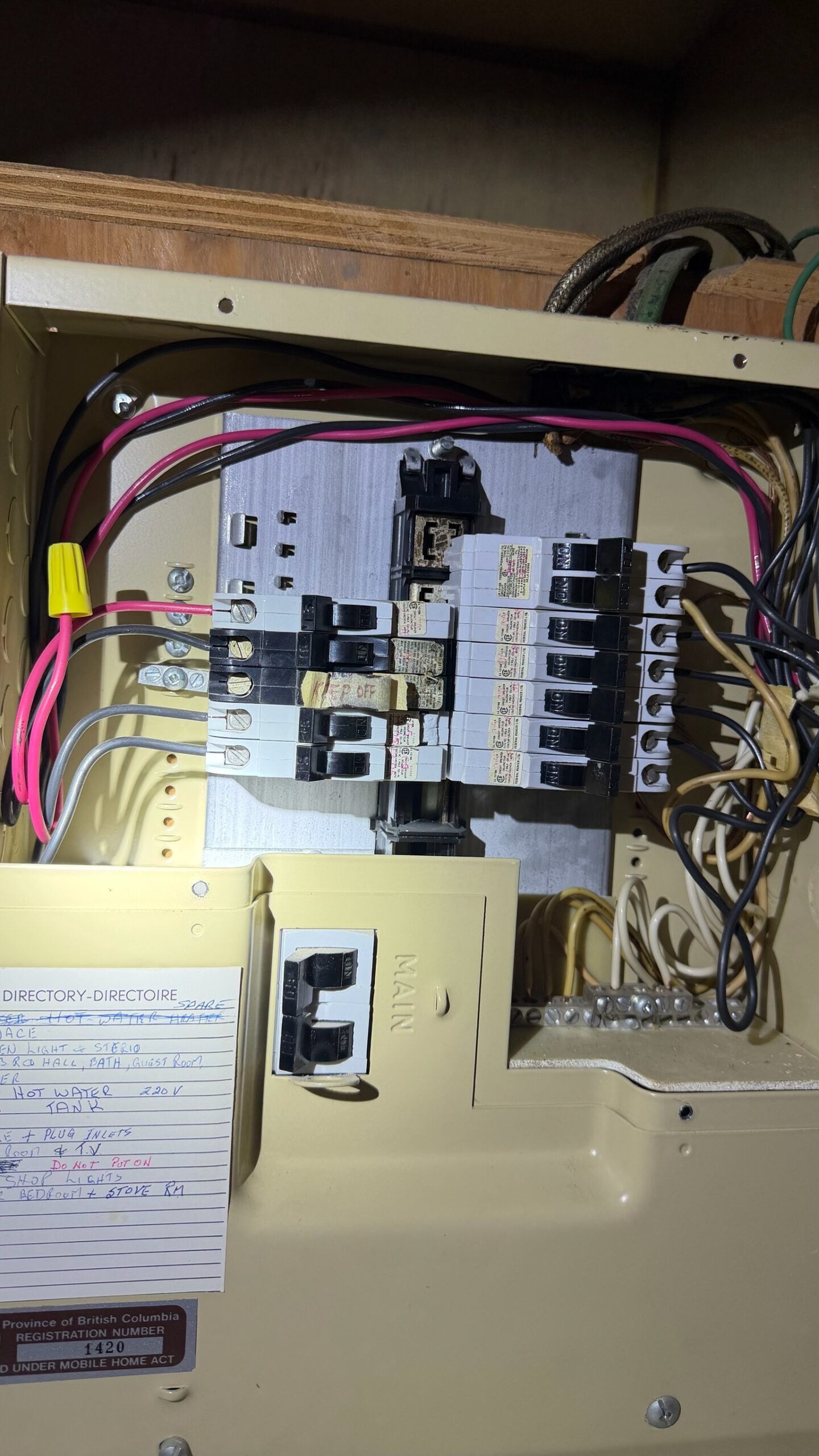
The Federal Pioneer and Stab-Lok markings identify the panel manufacturer and product line.
A circuit breaker is an automatic safety device. If current exceeds what a circuit and its wiring are intended to carry, the breaker should open within a prescribed period and interrupt the power. This reduces the chance that overloaded wiring will continue heating.
The central concern raised about Stab-Lok equipment is not that the panel necessarily creates an overload on its own. It is that some breakers have failed to trip as required when an overload occurs. That makes this a potentially hidden issue. A breaker can look normal, remain switched on for years, and never reveal how it will perform until it is actually called upon to protect the circuit.
Electrical equipment is only one part of the insurance picture in an older home. Buyers should also understand how insurers may approach aluminum wiring in Victoria and Vancouver Island homes, since the wiring type and the electrical panel can create separate due-diligence questions.
What Actually Happened in the United States?
In 1980, the parent company of Federal Pacific Electric reported to the U.S. Consumer Product Safety Commission that many FPE breakers did not fully comply with Underwriters Laboratories requirements. The CPSC later stated that its testing confirmed failures in certain UL calibration tests. Its investigation focused mainly on two-pole residential breakers manufactured before 1979.
The CPSC closed its investigation in 1983. This is frequently misrepresented online. The agency did not issue a blanket recall of all Federal Pacific panels, but it also did not declare the breakers safe. The CPSC said the available data did not establish that the breakers posed a serious risk of injury and that it could not connect the calibration failures to a hazardous condition based on the information then available.
The agency now places a note above its original release warning readers to interpret it carefully. The note specifically says the matter was closed without a determination about the safety of the breakers or the accuracy of the manufacturer’s position.
No. There was an investigation and confirmed failure of certain calibration tests, but no universal U.S. recall. Saying the entire brand was recalled is inaccurate.
Independent testing conducted after the CPSC investigation has reported additional failures, especially among certain two-pole breakers. The reported percentages vary substantially depending on breaker type, sample, test current, and test method. Those figures should not be converted into a claim that a specific breaker in a specific home has the same probability of failing.
Was There a Canadian Recall?
There was a limited Canadian action, not a recall of the entire Federal Pioneer product line. A 1997 Schneider Canada notice addressed specific 15-amp single-pole breaker models from a defined manufacturing period. The concern was that affected breakers might not trip as intended under some conditions.
That narrow recall is relevant history, but it does not justify describing every Federal Pioneer panel as recalled. Model numbers, production dates, and the exact equipment installed matter. If recall status is a concern, a licensed electrical contractor can document the installed equipment and confirm whether any specific notice applies.
What Technical Safety BC Says Today
Technical Safety BC addressed Federal Pioneer and Federal Pacific panels in its 2026 public guidance. It notes ongoing concern with panels and breakers installed in Canada from approximately the 1950s through the early 2000s. Importantly, it does not require replacement based solely on the manufacturer.
Its guidance is to consider the age and condition of the electrical equipment as part of maintenance planning, consult a licensed electrical contractor when there are concerns, and verify any implications with the insurance provider because insurers may set their own requirements.
That is a useful middle ground. The brand alone is not a complete diagnosis, but it is relevant information that a buyer should not discover after removing subjects.
Why I Identify Them Regardless of Age
A newer-looking panel or breaker does not eliminate every relevant question. The concerns are not limited to rust, scorching, loose connections, or other defects that can be seen during a visual inspection. Breaker trip performance is an internal functional issue that cannot be confirmed by looking at the face of the breaker.
I also cannot determine from appearance alone how an insurer will underwrite the home or what position the electrician selected by the buyer will take. Calling out the brand allows the buyer to investigate those questions before becoming committed to the property.
What I Can Report
The manufacturer and product markings, panel capacity, accessible visible conditions, signs of overheating or corrosion, improper breaker installation, open knockouts, crowding, and other observable concerns.
What I Cannot Confirm Visually
Whether every breaker will trip within its required time under overload, the condition of concealed connections, or whether a particular insurer will accept the equipment.
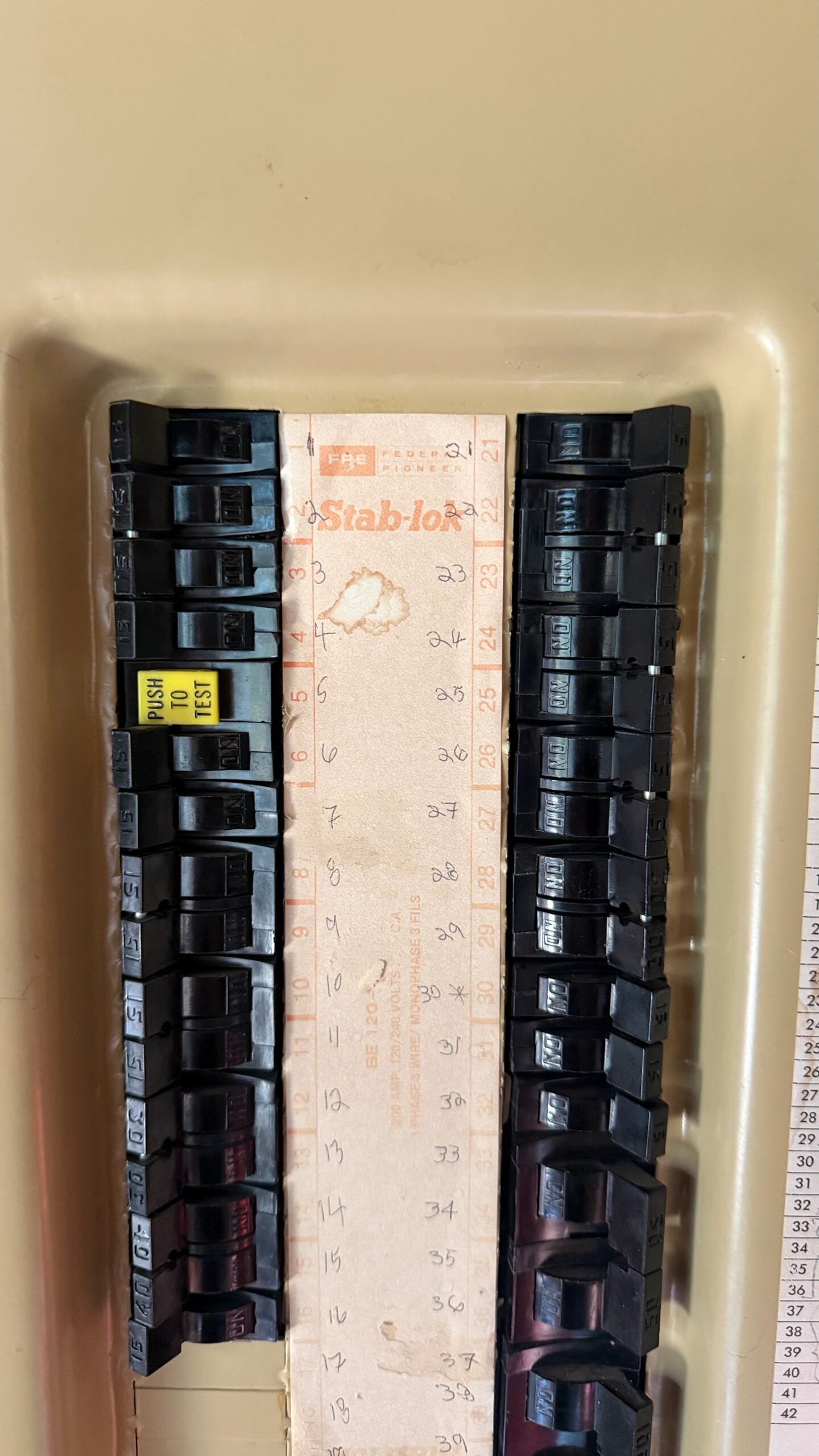
A Federal Pioneer Stab-Lok panel identified during a Vancouver Island home inspection.
Does a Clean-Looking Panel Pass?
A clean panel is better than one with visible overheating, corrosion, damaged components, loose breakers, missing covers, or amateur modifications. It does not resolve the product history or verify breaker calibration.
The reverse is also true. Finding a Federal Pioneer label is not, by itself, visual proof that the installed panel has failed or is actively overheating. The report should distinguish the brand history from any defects actually observed in that particular panel.
This same distinction applies throughout older houses. A recognizable material or brand can be relevant without proving that a failure has occurred. My guide to costly defects in Victoria heritage homes covers several other systems where age, condition, and inspection limitations all need to be considered together.
Should the Panel Be Replaced?
That decision should come after a licensed electrical contractor reviews the installation and the buyer confirms the insurer’s position. In some transactions, replacement will be the clearest long-term option. In others, the electrician may recommend a different scope based on the panel’s condition, service size, breaker availability, planned renovations, and the rest of the electrical system.
Replacement may also make practical sense when the panel is full, the home needs greater electrical capacity, compatible modern protective devices are difficult to obtain, visible defects are present, or renovation work is already planned. Those are project-specific reasons, separate from simply reacting to the brand name.
- Ask a licensed electrical contractor to assess the panel before subject removal.
- Confirm with the proposed home insurer whether the panel affects coverage, conditions, or premiums.
- Obtain a replacement quote when the electrician recommends replacement or when the buyer wants cost certainty.
- Do not attempt to remove the panel cover or test breakers under load yourself.
- Treat visible overheating, burning odours, buzzing, arcing, or a hot panel as an immediate electrical concern.
What About Replacing Only the Breakers?
Replacing one damaged or incompatible breaker is not the same as evaluating the complete panel. The breaker, its connection to the bus, the panel interior, and the compatibility and approval of any replacement component all matter.
A homeowner should not buy used, reconditioned, or supposedly compatible breakers online and assume the issue is solved. Any component replacement should be selected and installed by a licensed electrical contractor in accordance with the panel labelling and applicable requirements.
Insurance Can Be the Deciding Factor
Insurance requirements are not uniform. One insurer may accept a Federal Pioneer panel, another may request an electrical inspection, and another may require replacement before binding coverage. Those underwriting decisions can also change over time.
For a buyer, the practical answer is to ask the actual insurer who will cover the home. A general statement from a seller, realtor, inspector, or previous insurer is not a substitute for written confirmation on the proposed policy.
Federal Pioneer equipment is one of several issues that can affect a purchase without being obvious in listing photographs. See the broader guide to home inspection red flags in Victoria, BC for other concerns worth investigating before subject removal.
Realtor Insight
When a Federal Pioneer panel is visible in listing photos or identified during an inspection, deal with it early. The most useful sequence is electrician review, insurer confirmation, and a replacement quote if required. That gives the buyer real information instead of letting the discussion become a vague argument over whether all Stab-Lok panels are dangerous.
It is also important not to advertise the panel as “recalled” unless the installed breaker has been matched to a specific recall notice. The accurate description is that Federal Pioneer Stab-Lok equipment has a documented and disputed safety history, including a limited Canadian breaker recall and a major U.S. investigation, and that qualified review is recommended.
The Bottom Line
Federal Pioneer Stab-Lok panels deserve attention, but they deserve accurate attention. There was no blanket American recall and no recall of every Canadian Federal Pioneer panel. There were confirmed U.S. calibration-test failures, a CPSC investigation that ended without a safety determination, later independent testing that raised further concerns, and a limited Canadian recall affecting particular breakers.
That history is enough reason for me to identify the brand every time I find it. It is not enough reason to claim that every panel is currently failing.
For buyers in Victoria and across Vancouver Island, the sensible next step is a licensed electrical contractor’s assessment and direct confirmation from the intended insurer before subject removal. That turns a complicated brand history into a practical decision about the actual home.
Sources and Further Reading
- Technical Safety BC: 2026 guidance on Federal Pioneer and Federal Pacific panels
- U.S. Consumer Product Safety Commission: 1983 FPE investigation closing statement
- Jess Aronstein: Hazardous FPE Circuit Breakers and Panels technical report
- Canadian Federal Pioneer history and limited breaker recall references
- Schneider Electric Canada: Stab-Lok product information
Further Reading from Watchtower
- Aluminum Wiring in Victoria and Vancouver Island Homes
- Buried Oil Tanks in Victoria and Vancouver Island Homes
- Top Home Inspection Red Flags in Victoria, BC
- 5 Costly Defects I Find in Victoria Heritage Homes Every Month
- Cast-Iron Plumbing: A Critical Factor in Victoria Homes
- Browse All Watchtower Home Inspection Articles
Have Questions About an Older Home?
If you are buying a home with a Federal Pioneer panel in Victoria or elsewhere on Vancouver Island, the panel is only one part of the electrical system. A detailed home inspection can document the accessible conditions and help you determine which questions need to be answered before subject removal.
FAQ: Federal Pioneer Panels in BC
Were Federal Pioneer panels recalled?
There was no recall of every Federal Pioneer panel. Canada had a limited 1997 recall involving specific 15-amp single-pole breakers from a defined production period. The exact model and production information must be checked before saying a particular breaker was recalled.
Were all Federal Pacific Stab-Lok panels recalled in the United States?
No. The U.S. Consumer Product Safety Commission investigated Federal Pacific breakers and confirmed that certain breakers failed UL calibration tests, but it closed the investigation in 1983 without issuing a universal recall or making a determination that the breakers were safe or unsafe.
Does Technical Safety BC require Federal Pioneer panels to be replaced?
No. Technical Safety BC says it does not require replacement based solely on the manufacturer. It recommends considering the age and condition of the equipment, consulting a licensed electrical contractor when concerned, and confirming any requirements with the insurance provider.
Can a home inspector tell whether a Federal Pioneer breaker will trip?
Not through a standard visual home inspection. An inspector can identify the equipment and report accessible visible conditions, but cannot verify the internal calibration and future trip performance of every breaker.
Will home insurance cover a property with a Federal Pioneer panel?
It depends on the insurer and the specific installation. Some insurers may accept the panel, some may request an electrical assessment, and some may require replacement. Buyers should obtain direct confirmation from their intended insurer before subject removal.
Should I replace a Federal Pioneer panel before buying a home?
Have a licensed electrical contractor assess the panel and confirm the insurer’s requirements first. Replacement may be recommended because of visible condition, capacity, component availability, planned renovations, insurer requirements, or the buyer’s preference for a modern panel.